
Talleres Feudo SL — Comparison
Need plasma cutting? Compare it with fibre laser first
We do not cut with plasma, we cut with laser. This page sets out how they really differ and the cases where plasma is still the right choice.
Send us your drawingBefore you ask for a price
First things first: we do not do plasma here
If you arrived looking for plasma cutting, you should know it from the first paragraph: at Talleres Feudo we cut exclusively with fibre laser. We do not have a plasma table and we are not going to pretend otherwise.
This page exists because a good share of the people who ask for plasma ask out of habit, not because they have compared. For many years plasma was the obvious answer for medium and thick plate, and that habit has stuck. High-power fibre lasers have shifted that balance considerably over the last decade.
So below you have the comparison with the figures, including the part where plasma still wins. If your part is one of those, we will tell you and not waste your time.
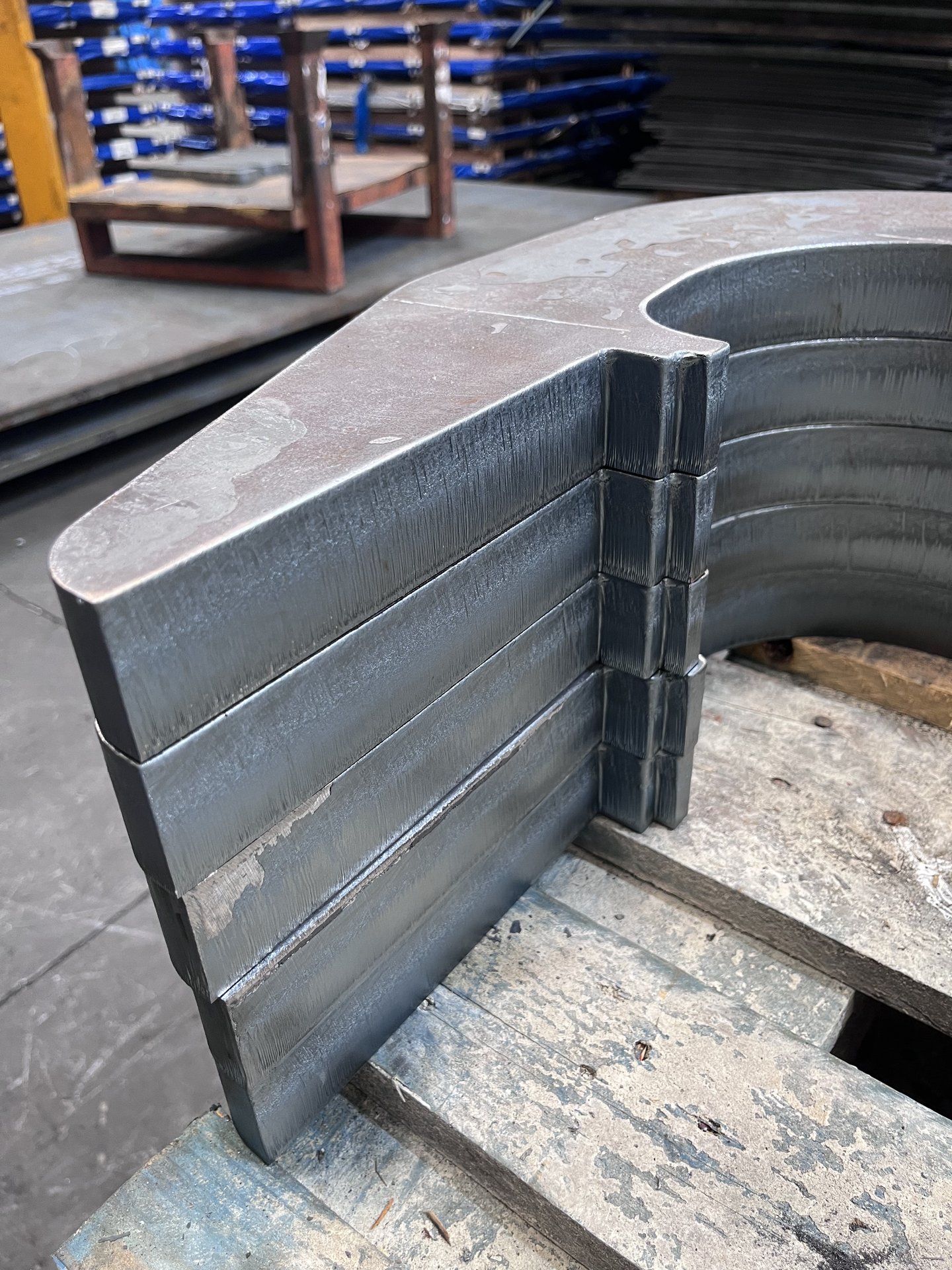
No sneering
What plasma cutting is and what it does well
Plasma cutting passes a gas through an electric arc until it ionises. That plasma leaves the torch at a very high temperature, melts the metal, and the jet itself blows the molten material away. It is a mature, robust technology with real strengths:
- It cuts any conductive metal. Carbon steel, stainless, aluminium. The alloy does not matter to it.
- It does not care about the state of the plate. Rusty, heavily scaled, painted or dirty: it cuts all the same. The laser is considerably more sensitive to surface condition.
- It is fast at medium thicknesses and the equipment costs a fraction of a high-power fibre laser, which shows in the hourly rate.
- It reaches high thicknesses. High-current systems cut steel well above the 50 mm we reach with the laser.
- It is portable. There are units you can take to site, which simply does not exist with a bed laser.
None of the above is a flaw. These are the reasons plasma is still installed in thousands of workshops, and why for certain parts it is exactly what you should be using.
Figure by figure
Plasma versus fibre laser
Indicative values for each technology on carbon steel. The laser figures are ours; the plasma ones are typical of an industrial system in good condition.
| Feature | Fibre laser | Plasma |
|---|---|---|
| Dimensional tolerance | ±0.1 mm up to 20 mm ±0.2-0.3 mm from 20 to 50 mm |
±0.5 mm |
| Edge squareness | Very high, practically square | The arc is conical and leaves a few degrees of taper on the edge |
| Kerf (cut width) | Tenths of a millimetre | Of the order of 2 to 4 mm depending on current and thickness |
| Heat-affected zone | Minimal | Medium |
| Small holes | Diameter below the thickness: ≈ half at 50 mm ≈ a third at 40 mm ≈ a quarter at medium thicknesses |
As a rule of thumb, diameter does not go below 1.5-2 times the thickness |
| Edge condition | Clean, ready to weld | Adhering dross and drag lines; altered surface layer |
| Secondary dressing | Normally none | Deburring and dross removal almost always |
| Weld preparation (bevel) | In the same operation, 360°, up to 30 mm | Requires a tilting head or a separate operation |
| Machine hourly cost | Higher | Lower |
| Maximum steel thickness | 50 mm (ours) | Well above, with high-current systems |
Note that the last two rows are marked in plasma's favour. A comparison where the same side always wins is no use for deciding anything.
The number that matters
The cost that is not in the machine rate
The laser hour costs more. The finished part, often, does not.
Deburring
A plasma-cut part comes off with dross adhering to the underside and an edge that almost always needs dressing. That is one person with an angle grinder, part by part, and on a production run it multiplies.
Holes you have to drill
If the drawing has holes of small diameter relative to the thickness, plasma cannot produce them round and they have to be drilled afterwards. Every hole is a machining operation that does not exist with the laser. With the laser the diameter can go below the thickness: around half of it in 50 mm plate, a third at 40 mm and a quarter at medium thicknesses.
Fettling at assembly
With ±0.5 mm per part and an edge that is not square, an assembly of several parts stacks up deviations. What you save on cutting you spend on shimming, forcing and dressing during assembly.
The nitrided layer
When plasma cuts with air, nitrogen is taken into the surface layer of the edge. Welding straight onto it can cause porosity, so on parts with welding requirements it has to be ground off first.
The material the kerf takes
With 2 to 4 mm of cut width against a few tenths, on a tight nest with many parts the difference in sheet consumed stops being trivial.
The chamfer
If the part is butt welded and needs edge preparation, on the laser it is produced in the same operation as the contour. Any other way it is a second machine or hand grinding.
Honesty
When plasma is the right choice
There are clear cases where plasma is a better decision than laser, and where we are not your supplier:
- Above 50 mm in carbon steel. That is our ceiling. From there you need high-current plasma or oxy-fuel cutting.
- Heavily rusted, scaled or painted plate. Plasma eats through it without blinking; the laser gives cut quality problems.
- Stainless and aluminium at medium to high thickness. Plasma cuts them normally. We only handle those materials on request and with customer-supplied stock.
- Cutting on site or on an assembled structure. A bed laser does not leave the shop.
- Large parts, no small holes and no tolerance requirement, where the only thing that counts is the cutting price. If the part carries no downstream work, plasma is hard to beat.
If your case is one of these, you already have your answer without needing to ask us for a quotation.
Our range
What we can do
Three capabilities, independent of each other. If your part falls within any of them, it is worth comparing.
Up to 50 mm thick
Carbon steel from 1 to 50 mm with a laser finish across the whole range. A 50 mm part comes out with the same edge as a 25 mm one; what changes is the cutting speed.
Formats up to 8,000 mm
Sheet up to 8,000 × 2,000 mm, to produce long parts in one go. This is a separate capability from maximum thickness: if your part combines the two, confirm it with us using the drawing.
360° bevel up to 30 mm
Single and double weld preparation (V, X, K, Y) in the same operation as the cut, including on curved contours. No grinding or machining afterwards.
FAQ
Frequently asked questions about plasma and laser
No. We cut exclusively with fibre laser. We made that choice years ago and this page exists to explain why, not to sell you something we do not have. On most carbon steel parts up to 50 mm the laser gives a better result and, once the downstream work is counted, works out cheaper. If your part is one that plasma handles better, we will say so.
The laser machine rate is usually higher. The price of the finished part often is not, because a plasma-cut part almost always needs deburring, dross removal, edge dressing and, if it has small holes, subsequent drilling. Those operations do not show up in the cutting price, but somebody pays for them.
We cut carbon steel up to 50 mm with a laser finish across the whole range. That is the band where the laser replaces plasma with a clear advantage. Above 50 mm we no longer reach, and you need high-current plasma or oxy-fuel cutting.
Then plasma can be perfectly sensible, especially for a large part with no small holes that is not going to be butt welded. Precision costs money and it does not always pay off. What is worth doing is comparing the price of the finished part, not of the cut.
Yes, and it is the quickest way to find out whether it pays off. Send us the same file and we will come back with a laser price within 24 working hours. If the part also needs a weld chamfer, say so: on the laser it is produced in the same operation as the contour.
When plasma cuts using air as the gas, nitrogen from the air is taken into the surface layer of the cut face. That nitrogen-enriched layer can cause porosity in the weld if you weld straight onto it, which is why many workshops grind it off first. Laser cutting does not leave that layer.
Send us the same DXF you were going to send to plasma
We will tell you what it costs on the laser and whether it pays off, within 24 working hours. And if your part is better solved with plasma, we will tell you that too.