
Talleres Feudo SL — Comparison
About to order oxy-fuel cutting? Check what range the laser covers first
We do not do oxy-fuel cutting. But up to 50 mm the fibre laser has taken its ground, and above that oxy-fuel is still unmatched. Here is the boundary, explained.
Send us your drawingBefore you ask for a price
It all comes down to one boundary: 50 mm
To be clear from the start: at Talleres Feudo we do not do oxy-fuel cutting. We cut with fibre laser, and we reach 50 mm in carbon steel.
Oxy-fuel was for decades the only reasonable way to cut thick plate, which is why it remains the automatic reflex for many people in boilermaking and structural work. What has changed is that high-power fibre lasers have climbed into thicknesses that used to be the torch's exclusive territory.
The result is a fairly sharp boundary: from 10 to 50 mm the laser wins on almost everything, and above 50 mm oxy-fuel has no practical rival, because it reaches 300 mm and more with equipment that costs next to nothing in comparison.
On this page
No sneering
What oxy-fuel cutting is and where it is unbeatable
Oxy-fuel cutting does not melt the metal: it burns it. The steel is preheated with a flame up to ignition temperature and then a jet of pure oxygen is fired at it, oxidising the iron. That reaction is exothermic, meaning it generates its own heat and sustains itself, and the jet blows the molten oxide away. It is chemistry, not power.
From that come its two great strengths and its big limitation:
- Practically unlimited thickness. Because the reaction feeds itself, thickness barely penalises it. 300 mm is routine and heavy industry goes considerably further. No laser comes close.
- Dirt-cheap, portable equipment. Two bottles and a torch. You can cut on site, on an already assembled structure, or in a scrapyard.
- It only works on carbon and low-alloy steel. Stainless and aluminium form oxides that do not behave like iron's, so oxy-fuel will not cut them. That is a chemical limitation, not a power one.
Anyone calling oxy-fuel an obsolete technology is forgetting that above a certain thickness it is still the only sensible option. And it will be for a long time.
Figure by figure
Oxy-fuel versus fibre laser
Indicative values on carbon steel. The laser figures are ours; the oxy-fuel ones are typical of the process.
| Feature | Fibre laser | Oxy-fuel |
|---|---|---|
| Dimensional tolerance | ±0.1 mm up to 20 mm ±0.2-0.3 mm from 20 to 50 mm |
±1-2 mm |
| Heat-affected zone | Minimal | High, with edge hardening in some steels |
| Part distortion | Very low | Noticeable, especially on long narrow parts |
| Edge condition | Clean, ready to weld | Drag lines and dross adhering to the underside |
| Minimum detail and holes | High level of detail | Limited; small holes are drilled afterwards |
| Weld preparation (bevel) | In the same operation, 360°, up to 30 mm | Triple torch or separate machining, almost always with dressing |
| Materials | Carbon steel; others on request | Carbon and low-alloy steel only |
| Equipment and hourly cost | High | Very low |
| Cutting outside the shop | No | Yes, it is portable |
| Maximum steel thickness | 50 mm (ours) | 300 mm and more |
The last three rows are marked in oxy-fuel's favour, and not out of courtesy: they are real advantages no laser can argue with.
The invisible cost
Distortion, the cost nobody quotes for
It is the difference you notice most in the workshop and the one that appears least in comparisons.
Oxy-fuel needs to preheat the steel and keep it hot along the whole path. That puts an amount of thermal energy into the plate that bears no relation to the laser's, and that energy expands the material unevenly: the cut zone heats and grows, the rest does not, and when everything cools the part is left with internal stresses.
On a small compact part you barely notice. On a long, narrow part — a flange plate, a stiffener, a six-metre rib — the part comes out bowed. And then it has to be straightened: press, localised heating or both, with an operator tied up and no guarantee of recovering the original flatness.
The fibre laser concentrates the heat in a band of millimetres and moves fast, so the part comes out practically flat and can go straight to the next operation.
Weld preparation
The chamfer: triple torch versus laser bevel
People who order oxy-fuel are usually in boilermaking, structural steelwork or capital equipment. Which means: these are almost always parts that are going to be butt welded and therefore need edge preparation.
With oxy-fuel, that chamfer is produced in one of two ways. Either with a triple torch, which carries three nozzles angled to produce the bevel in the same pass, or by machining the edge afterwards. The first is fast but leaves an imprecise angle and dross that needs dressing; the second is accurate but is one more machine and one more handling of a heavy plate.
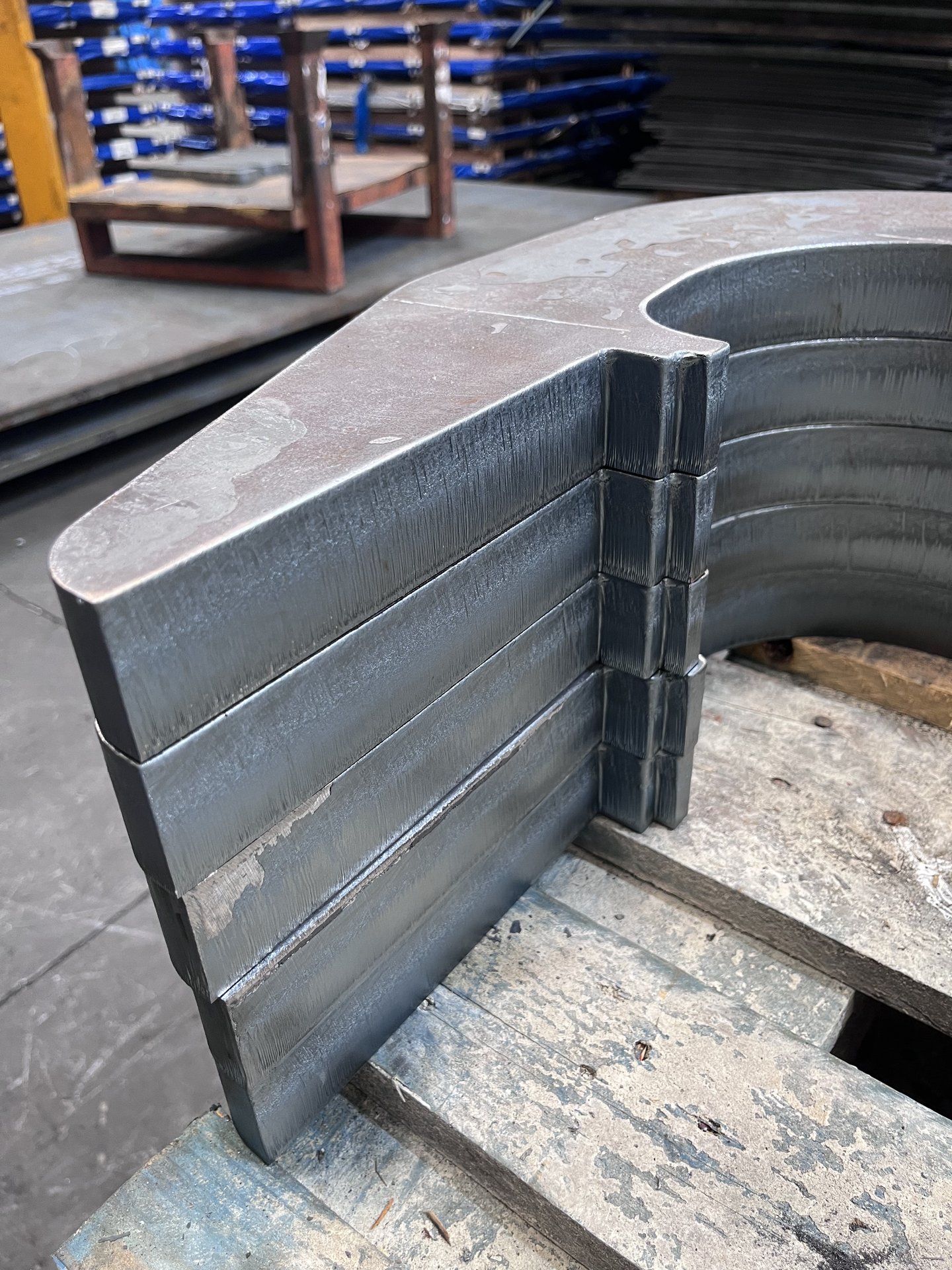
With the laser, up to 30 mm thick, the bevel is produced in the same operation as the contour: CNC-controlled angle, repeatable part to part, through 360° around the whole perimeter — including curved sections, which is where machining gets expensive — and in V, X, K and Y configurations.
The limit is worth stating too: above 30 mm we do not bevel. We cut the contour with the laser up to 50 mm, but the preparation has to be solved another way.
Honesty
When oxy-fuel is the right choice
Cases where oxy-fuel is a better decision than laser and where, quite simply, we are not your supplier:
- Above 50 mm. That is our ceiling and there is no arguing with it. From there, oxy-fuel.
- Very thick plate where tolerance does not matter. Bases, counterweights, scrapping work, rough breakdowns. Paying for precision nobody will use makes no sense.
- Cutting on site or on an assembled structure. The torch goes to where the part is; the laser does not.
- Very tight budgets on parts with no downstream work. If the part is not butt welded, has no fine holes and does not need straightening, oxy-fuel is hard to beat on price.
- One-off urgent parts in a workshop that already has the equipment. Nothing is faster than the torch that is already lit.
And one middle situation worth looking at: in many assemblies only one or two parts exceed 50 mm and everything else is below. There is no need to send the whole assembly to oxy-fuel because of those two.
Our range
What we can do
Three capabilities, independent of each other. If your part falls within any of them, it is worth comparing.
Up to 50 mm thick
Carbon steel from 1 to 50 mm with a laser finish across the whole range. The most requested thicknesses are 25, 30, 40, 45 and 50 mm.
Formats up to 8,000 mm
Sheet up to 8,000 × 2,000 mm, to produce long parts in one go. This is a separate capability from maximum thickness: if your part combines the two, confirm it with us using the drawing.
360° bevel up to 30 mm
Single and double weld preparation (V, X, K, Y) in the same operation as the cut, including on curved contours. No dross dressing and no angle correction.
FAQ
Frequently asked questions about oxy-fuel and laser
No. We cut exclusively with fibre laser, up to 50 mm in carbon steel. This page is not here to sell you oxy-fuel cutting, but so that you compare before ordering it: in the 10 to 50 mm band the laser has displaced oxy-fuel in almost everything. Above 50 mm oxy-fuel is still the answer and we are no longer your supplier.
Up to 50 mm in carbon steel, which is our ceiling. In that range the laser gives tolerances around ten times better, an edge ready to weld and far less distortion. Beyond 50 mm oxy-fuel has no practical rival: it reaches 300 mm and more.
Because the process has to preheat the steel with a flame and keep it hot along the whole path, so it puts far more thermal energy into the plate. That uneven expansion bows the parts, especially long narrow ones, and forces you to straighten them afterwards. The fibre laser concentrates the heat in a very narrow band and the part comes out practically flat.
Yes, up to 30 mm thick and with advantages: the bevel is produced in the same operation as the contour, with a CNC-controlled angle, through 360° around the whole perimeter including curved sections, and in V, X, K and Y configurations. There is no dross to dress and no angle to correct by grinding. Above 30 mm we cut the contour but the preparation has to be solved another way.
The machine rate, yes. The finished part depends on what comes next: dross removal, edge dressing, straightening the distortion and preparing the chamfer. On parts that get welded, those operations usually cost more than the difference in the cut. On large rough parts that carry none of that, oxy-fuel is cheaper, full stop.
We will tell you plainly and point you in the right direction, even though we cannot make it. There is also a middle option worth considering: in many assemblies only one or two parts exceed 50 mm and everything else is below. The work can be split rather than sending the whole lot to oxy-fuel because of two parts.
Send us the same drawing you were going to send to oxy-fuel
We will tell you what it costs on the laser and whether it pays off, within 24 working hours. And if your part is over 50 mm, we will say so plainly.