
Talleres Feudo SL — Navarra, Spain
Industrial CNC Machining in Navarra, Spain
More than 5 CNC machining centres with tables up to 3 metres. Drilling, tapping and milling with 4-axis capability — and machining of the welded assembly, once it has moved. Fifteen minutes from Pamplona.
Request a QuoteCNC Machining
CNC machining, and machining the assembly once it is welded
Our machining covers two different jobs, and it is worth keeping them apart, because they solve different problems.
The first is CNC machining to drawing: drilling, tapping and milling programmed on numerically controlled machines, with more than 5 machining centres, tables up to 3 metres and 4-axis capability with a dividing head, for parts that have to be machined on more than one plane.
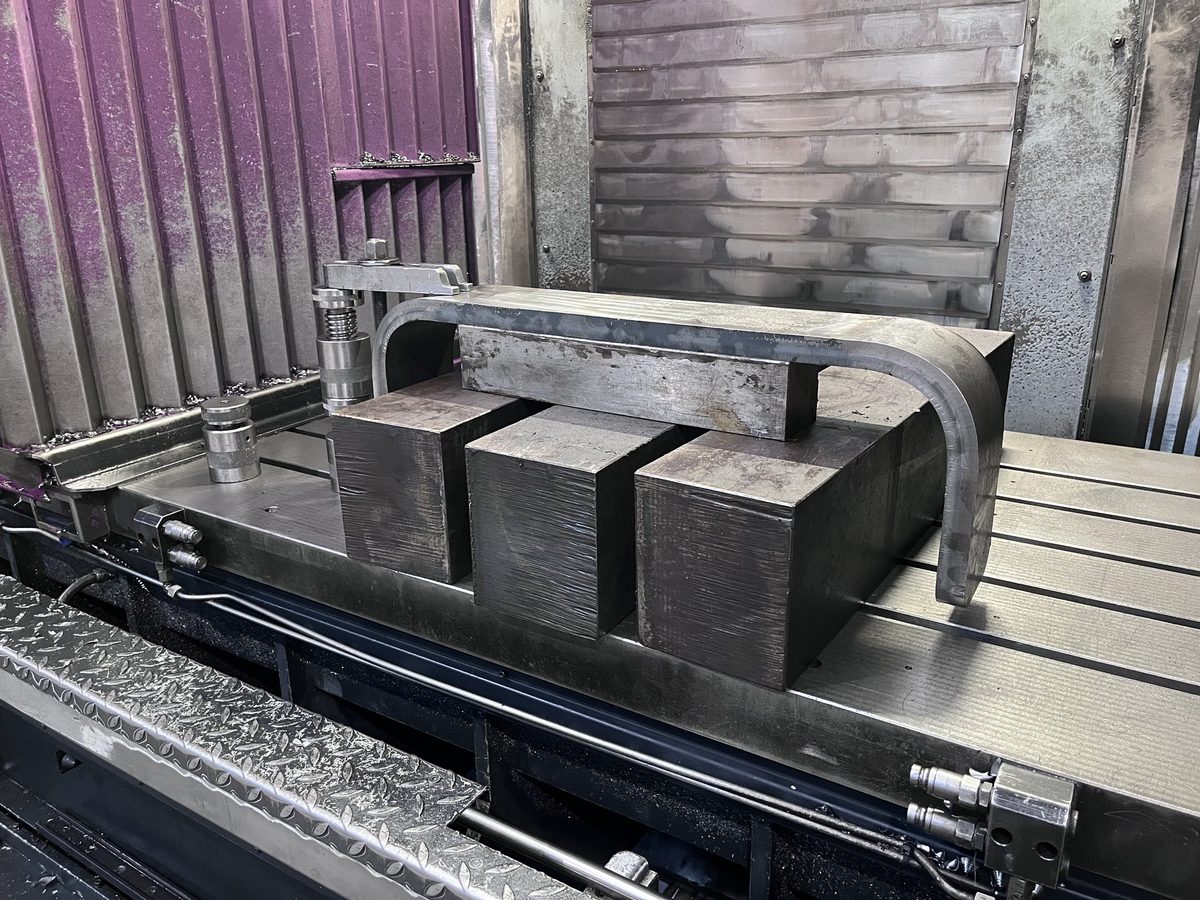
The second is the one almost nobody talks about, and it is where we are worth most to you: machining the assembly after it has been welded. Welding distorts. If the housings, the mounting faces and the reference holes are produced before welding, they will not line up afterwards. Producing them afterwards, on an assembly that has already moved and settled, is the only way a frame drops into your line first time — and that is exactly what a 3-metre table is for.
All of it joined up with laser cutting, bending, welding and assembly under one roof, 15 minutes from Pamplona, in a plant certified to ISO 9001:2015 by AENOR.
Technical Capabilities
Our CNC machining capabilities in Navarra
A machine list sized for real production runs and for parts that are too big for most subcontract shops to clamp.
CNC machining centres
More than 5 machining centres under numerical control. The program is proved out once on the first part and then repeats, so part one and part five hundred come off the machine to the same setting.
Tables up to 3 metres
Work tables up to 3,000 mm long. Enough to clamp a full frame or bed in one go, instead of splitting it into set-ups that never quite agree with each other. Loading is by overhead crane, up to 5 tonnes.
4 axes and dividing head
4-axis capability (X, Y, Z and head rotation) with a dividing head, for angular layouts and for faces that are not square to the table: equally spaced holes, radial slots, machining on more than one plane in a single clamping.
Machining Operations
The operations we run every day
Our scope on the machining centres is milling and hole work, on flat parts, on prismatic parts and on welded assemblies:
- Drilling: holes to the diameter and depth on your drawing, on more than one plane thanks to the fourth axis. Where the drawing calls for a close fit we finish the hole by reaming rather than drilling straight to size.
- Tapping: internal and external threads, metric, Whitworth, UNC and UNF, blind or through. Cut under numerical control, so thread start and depth are the same on the first part and on the last one.
- Milling: face milling, contour milling and pockets. Reference faces, keyways, slots and profiles machined from the same datum the part is later inspected against.
- Boring: bearing and pin housings bored to size, including housings on an assembly that is already welded — which is where the dimension really matters.
- Dividing head work: parts with an angular layout — equally spaced holes, radial slots, polygonal features and anything else that needs accurate indexing rather than a second set-up.
- Combined operations: as many operations as we can reach in one clamping. Fewer set-ups means less handling, less positioning error and less machine time on the quotation.
The difficult one
Machining the assembly after it has been welded
A welded frame does not leave the welding bay with the dimensions it went in with. The heat pulls the parts around and the assembly moves, however little. That is physics, not a defect.
So when a dimension is critical, the right order is not machine and then weld, but weld and then machine: the assembly is welded, allowed to settle, and only then are the housings, the mounting faces and the reference holes that everything else is built from taken out on the machining centre.
Doing that needs two things not many shops have together: a welding shop of their own — with welding jigs we design and build here, and welders qualified to EN ISO 9606-1 — and a machine with enough table to clamp the whole assembly in one piece. Our 3-metre tables are exactly that, and our overhead crane handles up to 5 tonnes, which is the practical limit on what we can move and ship as one piece.
For you the difference shows up at your assembly line, not at ours: the weldment arrives to size and goes together first time, instead of the problem showing itself when the part is already on the line and the supplier is 300 km away.
Why work with us?
What you get by subcontracting your CNC machining to Talleres Feudo
One supplier, whole part
Machining sits next to laser cutting, bending, welding and assembly in the same 4,000 m² plant. You buy the finished part, not four operations from four shops that each blame the previous one.
Capacity that absorbs peaks
More than 5 machining centres, so a long run does not block the machine your urgent job needs. Reference lead time for cutting plus machining is 1-2 weeks; genuine emergencies at 24-48 hours on request.
Parts most shops cannot clamp
Three-metre tables and a 5-tonne overhead crane. Frames, beds and welded structures that will not physically fit on a standard machining centre are routine work here.
Repeatability you can plan around
First-off checked before the run is released and the critical dimensions verified in process. Dimensional report and EN 10204 3.1 material certificate on request, agreed at quotation stage.
Navarra, and a straight road out
Fifteen minutes from Pamplona with direct access to the N-121. That cuts transport time and cost for customers in Navarra, the Basque Country, La Rioja and Aragon, and for the French side of the Pyrenees.
Since 1983, and no minimum order
Over forty years machining to customer drawings, with more than 20 people on the payroll. Quotation back in under 24 working hours, from one part, payment at 30 days.
Materials
Materials we machine
We are carbon steel people. That is what runs through the plant every day and that is where our tooling, our cutting data and our experience are:
- Carbon steel: S235, S275, S355 and other structural grades. The standard material here, both in welded plate fabrications and in solid parts.
- High-strength steels: Hardox, Strenx, Weldox and similar, on request, machined with tooling and cutting data adapted to the hardness.
- Stainless steel, aluminium and galvanised steel: on request only, with customer-supplied material.
We machine both welded sheet fabrications and solid parts, whichever the job calls for. If the steel has to arrive with a certificate behind it, say so with the enquiry rather than after the order.
| Item | What you can count on |
|---|---|
| CNC machining centres | More than 5 |
| Maximum table length | 3,000 mm |
| Axes | 4 axes (X, Y, Z and head rotation) with dividing head |
| Operations | Drilling, tapping, reaming, boring, face milling, contour milling and pockets |
| Machining scope | Milling and hole operations, on flat, prismatic and welded parts |
| Machining of welded assemblies | Yes, on the assembly once it is welded |
| Handling | Overhead crane up to 5 tonnes |
| Standard material | Carbon steel S235, S275, S355 |
| Other materials | Hardox, Strenx, stainless steel and aluminium, on request |
| Tolerance | As stated on your drawing, confirmed before we quote |
| Documentation | Dimensional report and EN 10204 3.1 material certificate, on request |
| Reference lead time | Cutting plus machining, 1-2 weeks |
| Minimum order | No minimum order quantity, from one part |
Sectors
Sectors we supply
We manufacture to the customer's drawing. These are the machined parts that leave here most often.
Automotive and commercial vehicle
Positional drilling and tapping on brackets, angle plates and chassis parts. This is our main sector, and the dimension that matters here is hole position: a millimetre out and the part will not go together on the line.
Machinery and capital equipment
Frames and base frames with bearing housings, mounting faces and reference holes machined after welding. This is the case where the final dimension decides whether the machine goes together at all.
Energy and structural work
Plates, flanges and brackets with precision hole patterns and countersinks, in runs where the position of every hole has to repeat part after part.
Agricultural and livestock equipment
Components for agricultural machinery and farm equipment: tapping, reaming and face milling on parts we have already cut or bent, delivered ready to bolt up.
Civil works, quarrying and lifting
Bored shaft and pin housings on handling structures, buckets and hoppers. In Hardox and Strenx on request, with tooling and cutting data adapted to the hardness.
FAQ
Frequently asked questions about industrial CNC machining
Drilling, tapping, reaming, boring, face and contour milling, pockets, and dividing head work for angular layouts. We have 4-axis capability (X, Y, Z and head rotation), so a part with features on several planes can often be finished in one clamping.
Our machining centres have tables up to 3,000 mm long, and our overhead crane handles up to 5 tonnes, which is the practical limit on what we can move and ship as one piece. That covers frames, beds and welded structures that most subcontract shops cannot physically clamp. Beyond that, send the drawing and we will tell you honestly whether it fits.
More than 5 CNC machining centres. In practice that means a long run does not tie up the plant: we can hold a series on one machine and still take your urgent job on another.
Yes, and it is where we add most. With laser cutting, bending, welding and machining under one roof we control the whole chain, so the datum used to machine the part is the same one used to cut and weld it. Fewer transports, fewer handovers, and nobody to argue with about who lost the dimension.
Mainly carbon steel — S235, S275, S355 — in welded fabrications and in solid parts. High-strength steels such as Hardox and Strenx on request, with tooling and cutting data adapted to the hardness. Stainless steel and aluminium on request only, with customer-supplied material.
Yes. The program is proved out on the first part, the first-off is checked against the drawing and only then is the run released. After that the numerical control does the repeating, with the critical dimensions verified in process rather than at the end, when a whole batch would already be scrap.
Milling and hole operations on machining centres: drilling, tapping, reaming, boring, face milling, contour milling and pockets, on flat parts, prismatic parts and welded assemblies. If your drawing needs an operation outside that scope, flag it when you ask for the quotation and we will tell you straight away whether we can solve it, instead of wasting your time.
We work to the tolerance stated on your drawing. What matters is that you state it: if one dimension is critical and the rest are not, mark it, because it changes the clamping, the order of operations and the machine time — and therefore the price. If the drawing calls for a tolerance tighter than usual, say so in the enquiry and we will confirm it before we quote.
It depends on the dimension. Welding distorts, so anything that has to end up in an exact position — housings, mounting faces, reference holes — is best taken out after welding, on the assembly once it has settled. Whatever is not critical can be machined beforehand, flat, which is cheaper. Send us the assembly drawing and we will propose the sequence.
Yes, on request. We verify the critical dimensions and issue the report if you need it for your goods-inwards file. We can also supply the EN 10204 3.1 material certificate for the steel used. Agree both when you ask for the quotation, because they affect the lead time.
Need industrial CNC machining in Navarra?
Send us the drawings and, if you have it, the 3D model. Quotation back in under 24 working hours, with no obligation: cutting plus machining typically 1-2 weeks, welded assemblies 2-3. No minimum order quantity.